
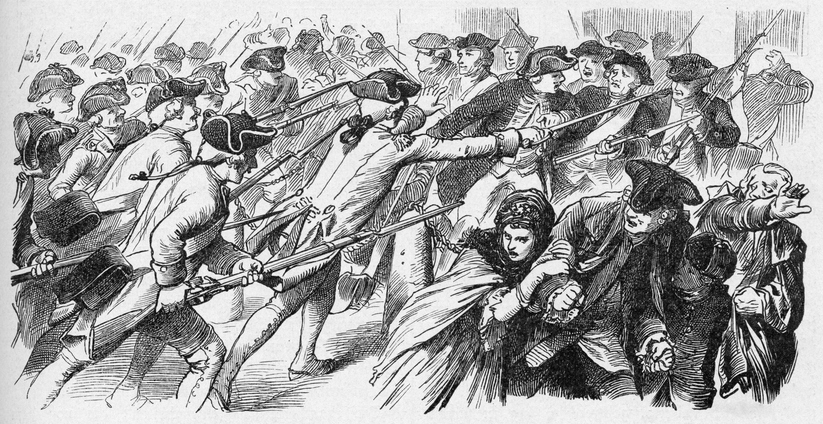
When most people think of early colonial resistance to British authority, their minds immediately jump to the Boston Tea Party of 1773. The bold act of throwing taxed tea into the harbor became a defining moment in American history. Yet, a year earlier, a group of frustrated colonists in New Hampshire staged their own violent uprising against the Crown. Their grievance was not over tea or stamps, but rather the majestic eastern white pine trees that populated their land.
The dispute centered on the Crown’s aggressive claim over the region’s most valuable timber. Settlers who had cleared land and built livelihoods suddenly found themselves barred from harvesting the very resources growing in their own backyards. Frustration simmered for decades before finally boiling over into outright violence in the small town of Weare, New Hampshire.
This uprising, now known as the Pine Tree Riot of April 1772, serves as a crucial chapter in the lead-up to the American Revolutionary War. It demonstrated a growing willingness among colonists to defy British mandates physically and legally. By examining this localized rebellion, we gain a clearer understanding of the widespread anger that eventually fueled the fight for American independence.
The King’s Broad Arrow Policy
To understand the fury of the New Hampshire colonists, one must look at the specific needs of the British Empire during the 18th century. The Royal Navy was the most powerful maritime force on the globe, but its massive fleet required constant maintenance. After centuries of shipbuilding, Great Britain had severely depleted its own domestic forests. They desperately needed massive, straight, and durable timber to construct the single-stick masts and booms for their warships.
The 1722 White Pine Law
The eastern white pines of New England provided the perfect solution. To secure this vital resource, the New Hampshire General Court passed a law in 1722, mirroring previous English mandates. Under this Broad Arrow Policy, it became illegal for colonists to harvest any white pine tree larger than 12 inches in diameter. These trees were strictly reserved for the Royal Navy.
Crown-appointed officials, known as Surveyors of the King’s Woods, traveled through the colonies identifying suitable mast pines. They marked these prized trees with the “broad arrow”—a series of three hatchet slashes shaped like an arrow. If a settler wanted to clear their own land of remaining white pines, they had to pay a substantial fee to obtain a royal license. Violators caught cutting down unmarked or illegal trees faced steep fines, often ruining them financially.
For many years, the policy was loosely enforced. However, when Governor John Wentworth took office in 1766, he decided to crack down on illegal logging. Wentworth sent his deputy surveyor, John Sherman, to inspect local sawmills, escalating tensions across the region.
The Conflict in Weare, New Hampshire
During the winter of 1771 and 1772, Sherman discovered that six mills in the towns of Goffstown and Weare possessed large white pines secretly harvested without royal permission. The offending mill owners were publicly named in The New Hampshire Gazette. Hoping to resolve the issue peacefully, the owners hired a lawyer named Samuel Blodgett to negotiate with Governor Wentworth.
Instead of defending his clients, Blodgett accepted a lucrative job offer from the governor to become a Surveyor of the King’s Woods. Returning to his former clients, Blodgett simply advised them to pay the fines and settle the matter. While the Goffstown mill owners reluctantly paid up, the men of Weare firmly refused to yield.
The Arrest of Ebenezer Mudgett
Because the Weare mill owners refused to pay the settlement, colonial authorities took direct action. On April 13, 1772, Hillsborough County Sheriff Benjamin Whiting and his deputy, John Quigley, rode into South Weare holding an arrest warrant. Their target was Ebenezer Mudgett, the prominent leader of the defiant mill owners.
Whiting successfully arrested Mudgett but allowed him to remain free for the evening after Mudgett promised to provide his bail money early the next morning. Confident that the situation was under control, the sheriff and his deputy retired for the night at Aaron Quimby’s local inn, the Pine Tree Tavern.
The Night of the Pine Tree Riot
Word of Mudgett’s arrest spread rapidly through the small farming community. Dozens of furious townsmen gathered at Mudgett’s home that evening. While a few men offered to chip in and pay the bail, the overwhelming consensus was to physically retaliate against the British officials. They formed a plan to run the sheriff and his deputy out of town.
Violence at the Quimby Inn
At dawn on April 14, Mudgett led a mob of 20 to 40 men to the Pine Tree Tavern. To conceal their identities, the rioters had blackened their faces with soot. They burst into Sheriff Whiting’s bedroom, catching him completely off guard.
Whiting attempted to grab his pistols, but the sheer number of rioters easily overpowered him. They grabbed him by his arms and legs, hoisted him into the air, and laid him face down on the floor. Using tree branch switches, the mob beat the sheriff mercilessly. According to historical accounts, they struck him with one lash for every contested tree the mill owners were accused of stealing. Whiting later stated that the mob nearly killed him.
Deputy Quigley suffered a similar fate. Another group of colonists ripped up the floorboards of the room above his, dragged him out, and beat him with long poles.
The rioters’ anger then turned toward the officials’ horses. They cropped the animals’ ears and sheared their manes and tails. The battered sheriff and deputy were forced onto their mutilated horses and driven out of Weare, riding through a gauntlet of jeering and shouting townspeople down the road toward Goffstown. You can read more about the specific details of this confrontation in this article from the Journal of the American Revolution.
A Slap on the Wrist
Humiliated and severely beaten, Sheriff Whiting immediately sought help. He recruited local military leaders who assembled a posse to return to Weare and arrest the perpetrators. By the time the soldiers arrived, the rioters had already fled into the surrounding woods.
Eventually, one participant was caught and revealed the identities of his accomplices. Eight men, including Mudgett, were ordered to post bail and appear before the Superior Court in Amherst in September 1772. They faced charges of rioting, disturbing the peace, and assaulting Benjamin Whiting.
When the trial commenced, the rioters pleaded guilty. However, the four presiding judges—including Meshech Weare, who would later become the first President of New Hampshire—handed down surprisingly lenient sentences. They fined each man a mere 20 shillings and ordered them to pay court costs. This incredibly light punishment highlighted the widespread colonial sympathy for the rioters and proved that British policies could be openly defied with minimal consequences.
Legacy and the Pine Tree Flag
While often overshadowed by events in Boston, the events in Weare held deep significance. The riot proved that organized, violent resistance against the Crown could succeed. According to Wikipedia’s Pine Tree Riot page, historians widely believe that the successful defiance in New Hampshire directly inspired the organizers of the Boston Tea Party just over a year later.
Furthermore, the white pine tree became a powerful symbol of colonial resistance. The “Pine Tree Flag,” featuring a green pine tree on a white background with the words “An Appeal to Heaven,” was flown by colonists during the revolution. It represented their refusal to submit to British tyranny and their reliance on a higher power to secure their liberty.
Many of the men involved in the riot, including several of the accused Weare townsmen, eventually enlisted to fight for the American side during the Revolutionary War.
Frequently Asked Questions
Why did the British need American pine trees?
During the 18th century, Great Britain had largely depleted its own forests. The Royal Navy needed tall, thick, and durable timber to serve as masts for their massive warships. The eastern white pine found in New England was considered the strongest and most suitable wood for this purpose.
What was the Broad Arrow policy?
The Broad Arrow policy was a British mandate reserving all white pine trees over a certain diameter for the Crown. Surveyors marked these trees with a symbol resembling three hatchet slashes. Colonists were forbidden from cutting down marked trees without paying for an expensive royal license.
Did anyone die in the Pine Tree Riot?
No. Although Sheriff Benjamin Whiting and Deputy John Quigley were brutally beaten with tree branches and poles, they survived the attack. The mob primarily intended to humiliate the officials and drive them out of town.
How did the Pine Tree Riot influence the American Revolution?
The riot demonstrated that colonists could aggressively organize against British authority and face very little legal consequence, as evidenced by the light fines handed down by the colonial judges. This successful defiance emboldened other colonists, paving the way for larger protests like the Boston Tea Party.
The Seeds of American Independence
The conflict in Weare was never just about lumber. It was a fierce reaction against an empire that attempted to control the property and livelihoods of its distant subjects. The men who blackened their faces and stormed the Pine Tree Tavern were defending their right to self-determination.
By pushing back against the King’s Broad Arrow policy, the people of New Hampshire signaled that their tolerance for British overreach had reached its limit. As you study the timeline of American independence, remember that the revolutionary fire was not only ignited in the bustling harbors of Massachusetts, but also deeply rooted in the quiet, pine-filled forests of New England.
Verified References
Key supporting points from sources
Considered a precursor to the American Revolution and similar protests like the Boston Tea Party
Cause of conflict:
British laws reserved white pine trees for Royal Navy masts, even on private land
Trigger event:
Arrest attempt of mill owner Ebenezer Mudgett led to organized resistance
The riot itself:
Colonists assaulted officials with sticks and drove them out of town
Aftermath:
Rioters were fined but not severely punished
Historical significance: