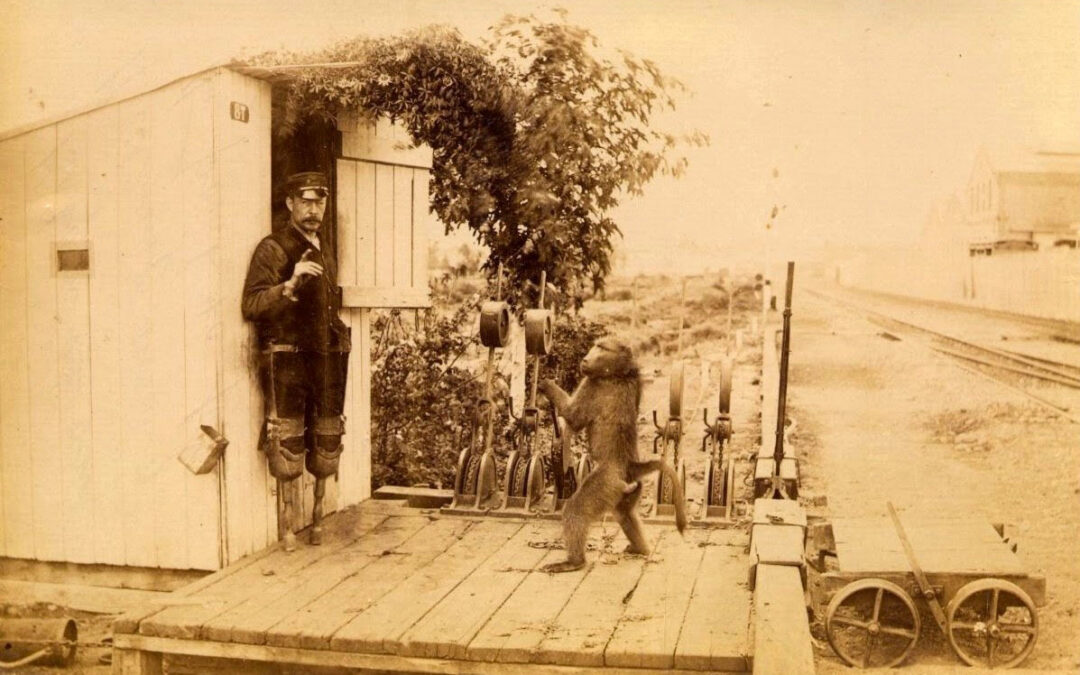
History is full of unusual partnerships, but few rival the bond between a double-amputee railway worker and a primate. During the late nineteenth century, passengers traveling through South Africa occasionally looked out their windows and noticed something deeply alarming. A large chacma baboon was standing in the signal box, firmly pulling the heavy metal levers that guided their trains safely down the tracks.
This was no rogue animal playing with dangerous machinery. The animal in question was Jack, a highly intelligent primate officially employed by the Cape Government Railways in the 1880s. Working as an assistant signalman, Jack spent nearly a decade successfully managing the heavy rail traffic at a busy junction.
This true historical account highlights an incredible display of animal intelligence and interspecies cooperation. By exploring the life of Jack the Baboon, you will learn how a devastating accident led to an unlikely friendship, how a primate passed a rigorous professional test, and why this particular baboon remains a celebrated figure in South African railway history.
A Devastating Accident and a Chance Encounter
The story of Jack begins with a man named James Wide. Known affectionately as “Jumper” Wide, he worked as a signalman and guard for the Cape Town–Port Elizabeth Railway service. He earned his nickname by daringly leaping between moving railcars to complete his duties. Unfortunately, this dangerous habit eventually caught up with him. One fateful day, Wide slipped during a jump and fell beneath a moving train, resulting in the amputation of both his legs below the knee.
Losing his legs could have easily ended Wide’s career. The half-mile commute to the Uitenhage train station alone was incredibly difficult, let alone the physical demands of managing heavy track levers. Determined to keep his job, Wide fashioned himself a pair of wooden peg legs and built a small trolley to help him get around. He still needed assistance, but finding a reliable helper proved challenging.
The solution appeared in the most unexpected place. While visiting a local market, Wide witnessed a primate expertly leading an oxcart down the street. Fascinated by the animal’s competence and focus, Wide approached the owner and purchased the chacma baboon. He named his new companion Jack, hoping the animal could help ease the physical burdens of his daily routine.
From Household Helper to Railway Signalman
Jack quickly proved to be a fast learner. Wide initially trained the baboon to help with simple household chores. Jack swept the floors, took out the trash, and most importantly, learned to push Wide’s small trolley to and from the train station every single day.
As the days turned into weeks, Jack observed everything Wide did inside the Uitenhage station signal box. Approaching train drivers used a specific whistle system to communicate with the signalman. A certain number of blasts indicated which track the train needed to take, prompting the signalman to pull the corresponding levers to switch the rails.
Jack started mimicking Wide’s actions. When a train blew its whistle, the baboon would grasp the correct lever. Wide soon realized that Jack had entirely memorized the complex whistle system. Recognizing the baboon’s incredible aptitude, Wide began actively training him to perform the signalman duties under strict supervision. Jack learned to identify each lever by name and precisely matched them to the specific whistle blasts of approaching trains.
Eventually, Wide grew so confident in his assistant’s abilities that he let Jack take over the primary signaling duties. The disabled railway worker could sit comfortably in the cabin, dedicating his time to his hobby of stuffing birds, while the baboon managed the railway switches outside.
The Official Railway Investigation
The unconventional arrangement worked flawlessly for months, but it was bound to attract attention. One afternoon, a wealthy passenger looked out the window of her passing train and gasped. Instead of a human railway employee, she saw a large primate operating the vital track switches. Horrified by what she perceived as a massive safety hazard, she immediately filed a formal complaint with the railway authorities.
Railway executives swiftly descended upon the Uitenhage station to investigate the bizarre claim. They expected to fire James Wide on the spot for gross negligence. Instead, Wide pleaded his case and challenged the executives to test Jack’s skills themselves.
The managers set up a rigorous examination. An engineer climbed into a locomotive and blew various complex whistle combinations, attempting to confuse the animal. Jack stood his ground. He correctly identified every single whistle blast, pulled the corresponding levers without hesitation, and even looked down the tracks to verify that the rails had engaged properly before allowing the train to pass.
Railway superintendent George B. Howe was completely astounded by the demonstration. He noted that the baboon knew the signal whistle just as well as any human employee, and the profound affection between Jack and his master was undeniable.
A Flawless Nine-Year Career
Rather than terminating Wide, the Cape Government Railways made a highly unusual decision. They officially hired Jack the Baboon.
As a formal employee of the South African railway in the 1880s, Jack received an official employment number. His compensation package consisted of 20 cents a day and half a bottle of beer every Saturday as a weekly bonus.
For the next nine years, Jack served as the primary assistant signalman at the Uitenhage station. The workload was demanding, requiring constant vigilance and immediate physical action. A single incorrectly pulled lever could result in a catastrophic train derailment, costing countless lives.
Despite the immense pressure, Jack operated with absolute precision. Multiple historical records and museum archives confirm a staggering fact about his career: Jack never made a single mistake. Every train that passed through his junction during that nine-year span reached its destination safely, guided by the steady hands of a baboon.
Discover More Extraordinary Animal Histories
Jack’s remarkable career came to a quiet end in 1890 when he contracted tuberculosis and passed away. His death deeply affected James Wide, who had lost both a vital set of hands and his closest companion. Today, Jack’s skull remains preserved in the collection of the Albany Museum in Grahamstown, South Africa, serving as a permanent testament to his intelligence and service.
The story of Jack the Baboon pushes the boundaries of how we understand animal intelligence and capability. If you found this historical account fascinating, consider visiting your local history museum or exploring archival archives to uncover more incredible stories of animals shaping human industry. You might be surprised to find just how much of our history relies on the paws, hooves, and hands of the animal kingdom.