
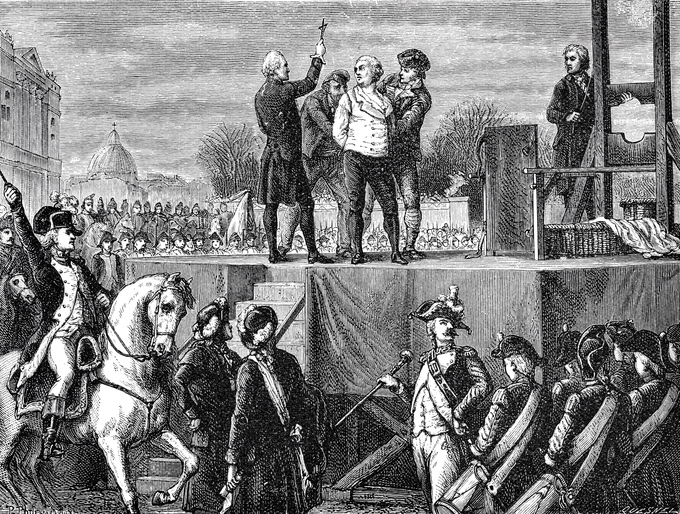
The French Revolution brought sweeping changes to European society, altering politics, class structures, and even the way criminals faced justice. On April 25, 1792, a massive crowd gathered in Paris to witness a new machine designed to deliver quick, equal punishment. That afternoon, a convicted highwayman named Nicolas-Jacques Pelletier became the first person executed by the guillotine. Read on to discover how this infamous device came to be, the details of its first use, and why the Parisian crowd left the square feeling deeply disappointed.
A Push for Humane Punishment
Before 1792, the French penal system relied on brutal methods of execution for commoners, such as hanging or breaking on the wheel. Wealthy aristocrats enjoyed the privilege of a quick beheading by sword. Dr. Joseph-Ignace Guillotin, a French physician and politician, argued that capital punishment should be equal across all social classes. He proposed a mechanical device to carry out a rapid and merciful death, regardless of the criminal’s status.
Designing the Machine
While Guillotin pitched the concept, Dr. Antoine Louis actually designed the prototype. Originally nicknamed the “Louison” or “Louisette,” the device featured a heavy blade suspended between two tall wooden posts. State executioner Charles-Henri Sanson tested the machine on live sheep, calves, and human corpses at the Bicêtre Hospital in Paris. After adjusting the blade to a sloping, triangular shape to ensure a clean cut, the machine was deemed ready for public use.
The Execution of Nicolas-Jacques Pelletier
Nicolas-Jacques Pelletier was a known highwayman who attacked and robbed a passerby in October 1791. A judge sentenced him to death, but authorities delayed the execution for months while the new beheading machine was built.
Finally, on the afternoon of April 25, 1792, Pelletier was led to a red-painted scaffold outside the Hôtel de Ville in the Place de Grève. He wore a red shirt, which was the traditional clothing for convicted murderers. Sanson moved quickly to position the condemned man. With a swift release of the weighted blade, Pelletier was decapitated in mere seconds.
A Disappointed Crowd
Public executions were major public events in 18th-century France. A large crowd gathered in the square, eager to watch the novel invention at work. However, the sheer efficiency of the guillotine left the onlookers feeling cheated. The death was so sudden and clinical that it lacked the dramatic, drawn-out spectacle of previous execution methods. Frustrated by the swiftness of the event, members of the mob actually chanted for the return of their wooden gallows.
The Dark Legacy of the National Razor
Pelletier’s swift death inaugurated an era of unprecedented bloodshed in France. The guillotine soon became a powerful symbol of the Reign of Terror, claiming the lives of King Louis XVI, Marie Antoinette, and thousands of other citizens. What started as a humanitarian effort by Dr. Guillotin transformed into one of history’s most infamous killing machines. To learn more about the French Revolution and its lasting impact on modern justice, consider exploring historical archives at your local library or watching documentaries that cover this turbulent period in European history.
Verified References
Credible sources
- Guillotine’s first execution (History.com)
- Confirms the historical event and context of the guillotine’s introduction during the French Revolution.
- First execution by guillotine in France (JURIST)
- States clearly: “On April 25, 1792, highwayman Nicolas-Jacques Pelletier became the first person beheaded by the guillotine in France.”
- Guillotine (Wikipedia overview)
- Notes that the first execution by guillotine occurred on April 25, 1792, and identifies the victim as highwayman Nicolas Jacques Pelletier.
- 25 April 1792: First use of the guillotine (HistoryPod)
- Explains that Pelletier, a highwayman convicted of robbery and murder, was the first victim of the device.
- 1792 in France (event listing)
- Lists the event succinctly: Pelletier became the first person executed by guillotine in France on April 25, 1792.