
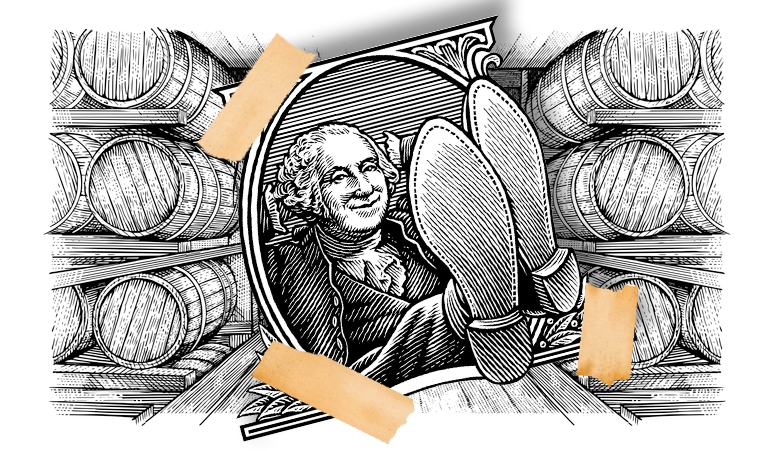
When we think of George Washington, we usually picture a revolutionary general or the first President of the United States. We rarely imagine him as a highly successful commercial distiller. Yet, shortly after stepping down from the highest office in the land, Washington embarked on a surprising new business venture.
In 1797, he established a commercial whiskey distillery on his Mount Vernon estate. Within just two years, this operation grew rapidly. It eventually produced nearly 11,000 gallons of liquor annually, bringing in significant revenue and cementing Washington’s status as a shrewd businessman.
This post explores the fascinating history of Washington’s post-presidency business. Read on to discover the origins of his Mount Vernon distillery, the scale of his massive production, and the traditional methods used to craft his famous un-aged whiskey.
A surprising retirement project
After completing his second presidential term in 1797, Washington returned to Mount Vernon looking to simplify his farming operations. He was always searching for ways to generate additional income from his expansive land holdings. During this time, his Scottish farm manager, James Anderson, approached him with an intriguing proposition.
Anderson had prior experience distilling grain in Scotland and Virginia. He recognized that Mount Vernon possessed all the necessary elements for a highly profitable distillery. The estate boasted abundant grain crops, a large merchant gristmill, and a steady water supply. Persuaded by Anderson’s business case, Washington agreed to fund the construction of a dedicated still house.
Construction began in the fall of 1797. The builders used large river rocks from the Potomac River for the foundation and quarried sandstone blocks from Mount Vernon itself for the walls. The resulting structure was built to last and designed for serious production.
Scaling to one of the largest in the country
Distilleries were very common in early America, with thousands operating in Virginia alone. However, Washington’s operation operated on an entirely different level. By 1799, the Mount Vernon operation stood as one of the largest whiskey distilleries in the country.
The building itself was enormous for its time. It measured 75 by 30 feet, creating 2,250 square feet of workspace. The average distillery in that era spanned only about 800 square feet. Inside, the facility housed a boiler and five large copper pot stills, holding a combined capacity of 616 gallons.
This massive infrastructure allowed the estate to produce staggering amounts of liquor. The average Virginia distillery operated for only one month out of the year, yielding about 650 gallons. Washington’s facility operated year-round. In 1799, it produced nearly 11,000 gallons of whiskey. This output generated a profit of $7,500, making the distillery one of Mount Vernon’s most lucrative enterprises.
The recipe and the enslaved workforce
Creating thousands of gallons of high-quality liquor required a specific recipe and a dedicated team of skilled laborers.
Making un-aged rye whiskey
The primary beverage produced at Mount Vernon was a rye whiskey. The standard recipe consisted of 60% rye, 35% corn, and 5% malted barley. Workers ran this mixture through the copper pot stills twice to create a common whiskey, though some batches were distilled up to four times for a higher price point.
Unlike modern spirits that sit in barrels for years to develop flavor, Washington’s whiskey was entirely un-aged. The final product was poured directly into uncharred 30-gallon wooden barrels. From there, workers sent it to merchants in Alexandria and Richmond, where it was consumed quickly. This rapid turnaround provided Mount Vernon with a fast and steady influx of cash.
The skilled distillers behind the scenes
While James Anderson and his son John managed the overall operation, the heavy daily labor fell to an enslaved workforce. Six enslaved African-American men—Hanson, Peter, Nat, Daniel, James, and Timothy—did the grueling, highly skilled work required to keep the stills running. They managed the fires, moved heavy barrels, cooked the grain, and monitored the complex fermentation processes.
Efficiency and the infamous whiskey tax
Washington ran a highly efficient agricultural business. He ensured that very little went to waste on his estate. The distillation process naturally produces a large amount of leftover cooked mash, commonly called slop. Rather than throwing this waste away, Washington built a large pen near the distillery to hold up to 150 hogs. The pigs fed on the nutrient-rich slop, growing exceptionally fat and providing additional food and revenue for the farm.
As a law-abiding citizen, Washington also paid federal taxes on his massive production. He paid an excise tax based on the capacity of his stills and the number of months they operated. In 1798, this tax amounted to $332. Ironically, this was the exact same “whiskey tax” that caused the famous Whiskey Rebellion during his presidency. Washington had personally led military forces into Pennsylvania to enforce the tax, and he faithfully paid it himself as a private citizen.
Experience the Mount Vernon distillery today
Following Washington’s death in 1799, the distillery continued operating for a few years under the management of his nephew. Unfortunately, a fire destroyed the building in 1814. The site sat dormant for decades until extensive archaeological excavations uncovered the original foundations.
In 2007, a fully functioning replica of the distillery opened to the public. Today, you can visit the exact location where Washington built his spirits empire. The reconstructed facility even produces limited batches of whiskey using the traditional 18th-century methods. If you want to learn more about early American industry, consider booking a trip to Mount Vernon to see the copper pot stills in action.
Verified References
Washington opened a distillery after his presidency
- George Washington began commercial distilling in 1797, after retiring from the presidency (which ended in 1797).
- The distillery was established at Mount Vernon at the suggestion of his farm manager, James Anderson.
This confirms: He opened the distillery after his presidency.
2. The distillery became one of the largest in the country
- Washington’s operation was “one of the largest whiskey distilleries in the country” at the time.
This supports (with slight nuance):
- Saying “the largest” is a common simplification, but the most precise wording is “one of the largest.”
3. Production reached about 11,000 gallons in 1799
- In 1799, the distillery produced nearly 11,000 gallons of whiskey.
This confirms the numerical claim is accurate.
4. The whiskey was un-aged
- Washington’s whiskey was not aged and was sold quickly after production.
So describing it as “un-aged whiskey” is correct.