
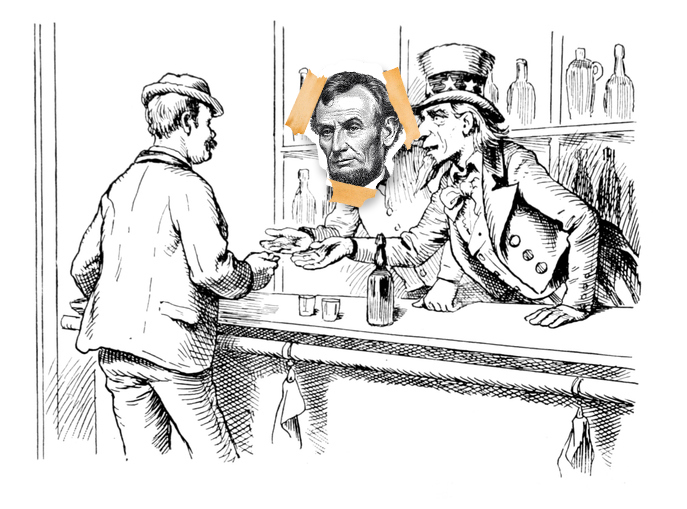
When we think of the sixteenth president of the United States, we usually picture a towering figure in a top hat, a seasoned statesman, and the Great Emancipator. We picture the man who delivered the Gettysburg Address and safely guided a fractured nation through the brutal American Civil War. Yet, long before he stepped into the Oval Office or even the political arena, Abraham Lincoln was just a young man trying to find his footing on the American frontier.
During his early twenties, Lincoln took on a variety of odd jobs to make ends meet. He floated a flatboat down the Sangamon River to New Orleans, worked as a clerk, and even served in the local militia. Among these early vocations lies a fascinating piece of trivia that often surprises history enthusiasts. Abraham Lincoln was a licensed bartender and a tavern owner.
This unexpected chapter of his life took place in the fading frontier village of New Salem, Illinois. It was a brief but impactful period that taught the future president difficult lessons about business, partnerships, and financial debt. Reading about his time pouring drinks and selling goods offers a unique glimpse into the everyday struggles of a young man who would eventually shape the course of American history.
Arriving in the Frontier Village of New Salem
In 1831, Abraham Lincoln was a young man of twenty-two looking for an opportunity. He and a few companions took a flatboat loaded with goods down the Sangamon River, eventually making their way to New Orleans. By mid-April of that year, he returned and settled in New Salem, Illinois. This small village, founded only two years earlier by James Rutledge and John M. Camron, served as the backdrop for Lincoln’s first real attempts at building a career.
Life in New Salem was rugged. The economy relied heavily on agriculture, river trade, and the few small businesses that supplied settlers with essential goods. A local merchant and entrepreneur named Denton Offutt had previously hired Lincoln for the New Orleans trip. Recognizing the young man’s strong work ethic, Offutt employed him as a clerk in his New Salem general store. This experience gave Lincoln his first taste of frontier commerce.
However, frontier businesses were notoriously unstable. Offutt’s store eventually failed, leaving Lincoln unemployed. With an election recently over and no steady job in sight, the ambitious young man had to look for other opportunities to support himself. He decided to become a merchant in his own right.
Forming the Lincoln-Berry General Store
In January 1833, Abraham Lincoln entered into a business partnership with a friend named William F. Berry. Together, they purchased a small general store in New Salem. Because neither man had the cash to buy the business outright, they purchased the store on credit from James and William Herndon.
The initial goal of the Berry and Lincoln partnership was to operate a standard general store, providing the local community with everyday necessities. Frontier general stores carried a wide variety of goods, ranging from tools and dry goods to clothing and basic groceries. Running a store was a respectable way to make a living and build a reputation in a small town.
Unfortunately for the two partners, the local economy was highly competitive, and the village of New Salem was already struggling to maintain its population. To increase their revenue, the partners realized they needed to offer something that consistently drew crowds. They decided to expand their business model to include the sale of alcohol, which required them to obtain a specific legal certification.
Securing the Bartending License
Selling liquor by the drink in 1830s Illinois was strictly regulated. A business owner could not simply open a barrel of whiskey and start serving customers. They needed official permission from the local government.
A surviving historical record confirms the exact date the partners formalized this new venture. On March 6, 1833, they obtained a license to keep a tavern in New Salem. Because a license was required to sell customers alcoholic beverages, William F. Berry officially obtained the bartending licenses for both himself and Lincoln. With the paperwork finalized, the Lincoln-Berry General Store officially became a tavern as well.
The Role of Taverns in Frontier Illinois
To understand this career move, you have to understand what a tavern meant to an early American village. In the 1830s, a tavern was a central gathering place for the community. It provided a space for locals to share news, discuss politics, and socialize after long days of difficult labor.
A licensed tavern was allowed to sell spirits in small quantities, meaning customers could purchase a single drink to consume on the premises. This differed from a standard general store, which could only sell alcohol in large quantities for customers to take home. By obtaining a bartending license, Lincoln and Berry positioned their store as a social hub. Visitors could buy a drink, sit down, and listen to Lincoln share his famous stories and jokes.
The Downfall of the Lincoln-Berry Partnership
While the idea of turning the store into a tavern seemed like a smart business decision, the execution proved disastrous. The primary issue was not a lack of customers, but rather the behavior of Lincoln’s business partner.
Historians like Michael Burlingame have noted that William F. Berry was an undisciplined, hard-drinking fellow. Instead of selling their stock of alcohol to paying customers, Berry consumed a significant portion of the shop’s supply himself. His raging alcoholism quickly drained the business of its most profitable inventory.
Furthermore, Lincoln’s personality contributed to their financial woes. He was known for being incredibly soft-hearted and frequently extended credit to customers who could not afford to pay. On the frontier, extending credit was common, but doing it too generously meant the store had no incoming cash to replenish its stock or pay off the original loan used to buy the business.
With Berry drinking the profits and Lincoln giving away goods on credit, the business rapidly deteriorated. According to Lincoln’s own later accounts, this business venture simply put him deeper and deeper in debt. Seeing no path to profitability, Lincoln sold his interest in the store to Berry in April 1833, shortly after they obtained the tavern license.
The Burden of the National Debt
Exiting the partnership did not instantly solve Lincoln’s financial problems. The store eventually failed completely. Because the business had been purchased on credit, the closure left Lincoln struggling with a massive burden of debt. He jokingly referred to this financial obligation as his “national debt.”
It took Lincoln years of careful saving and hard work in other professions to finally pay off what he owed from the failed tavern venture. He worked as a postmaster and a surveyor, using his earnings to satisfy his creditors. This experience instilled in him a deep respect for financial responsibility, a trait that would later influence his approach to the nation’s economy.
During his presidency, Lincoln helped shape major fiscal and monetary policies. He signed the Revenue Act of 1861, which imposed the first U.S. federal income tax, and the Legal Tender Act in 1862, which authorized the minting of the first U.S. government banknotes since the American Revolution. He also pushed for the National Banking Act in 1863 to stabilize the country’s currency. The man who once struggled to manage the finances of a small frontier tavern ultimately managed the complex economy of a nation at war.
Leaving New Salem Behind
By the late 1830s, the village of New Salem was fading. The Sangamon River proved too difficult for large steamboats to navigate, stifling the town’s economic growth. Residents began packing up and moving to more prosperous areas.
After the Illinois State Legislature adjourned on March 6, 1837, Lincoln returned to New Salem one last time. He saw no future there for legal work or wider political opportunities. On April 15, 1837, Lincoln packed his belongings and moved to Springfield, Illinois. There, he would establish his law practice, build his political career, and eventually launch his campaign for the presidency.
Frequently Asked Questions
Was Abraham Lincoln actually a licensed bartender?
Yes. On March 6, 1833, a bartending license was obtained in his name alongside his business partner, William F. Berry. This allowed their general store in New Salem to operate as a tavern and sell alcohol by the drink.
Why did the Lincoln-Berry General Store close?
The business failed primarily due to poor management and the personal habits of the owners. William F. Berry was a heavy drinker who consumed much of the tavern’s alcohol supply, while Abraham Lincoln generously extended store credit to customers who rarely paid off their tabs. The business fell deeply into debt.
How did Lincoln pay off his debt from the failed tavern?
Lincoln took on various jobs after the store failed, including working as the local postmaster and a deputy land surveyor. He lived frugally and used his earnings over several years to completely pay off his share of the debt, which he humorously called his “national debt.”
Where is New Salem located today?
New Salem is located in Menard County, Illinois, near Petersburg. The original village was abandoned shortly after Lincoln left for Springfield in 1837. Today, it operates as Lincoln’s New Salem State Historic Site, featuring reconstructed log cabins and a replica of the Lincoln-Berry General Store.
Discover More About Lincoln’s Early Years
Abraham Lincoln’s time as a bartender is a compelling reminder that the path to greatness is rarely a straight line. His early failures in business taught him resilience, financial responsibility, and the importance of choosing the right partners. These hard-won lessons undoubtedly shaped the character of the man who would guide the United States through its darkest hour.
If you want to explore more surprising stories about America’s past presidents, consider visiting the reconstructed village of New Salem in Illinois, or check out our other historical guides focusing on the hidden lives of America’s greatest leaders.
Verified References
Lincoln co-owned a store that became a tavern (1833)
- The Abraham Lincoln–William F. Berry partnership is well documented:
“In January 1833, he entered into a partnership with William F. Berry to purchase a small store.”
- The business did sell alcohol under a license:
“Berry obtained bartending licenses… and in 1833 the Lincoln-Berry General Store became a tavern as well.”
They “obtained a license… March 6, 1833… to keep a tavern in… New Salem.”
Burlingame also cites contemporaries describing Berry in even harsher terms:
Berry was “wild and dissipated.”
The business failed and left Lincoln in debt
“This venture didn’t last long… [and] put him deeper and deeper in debt.”