
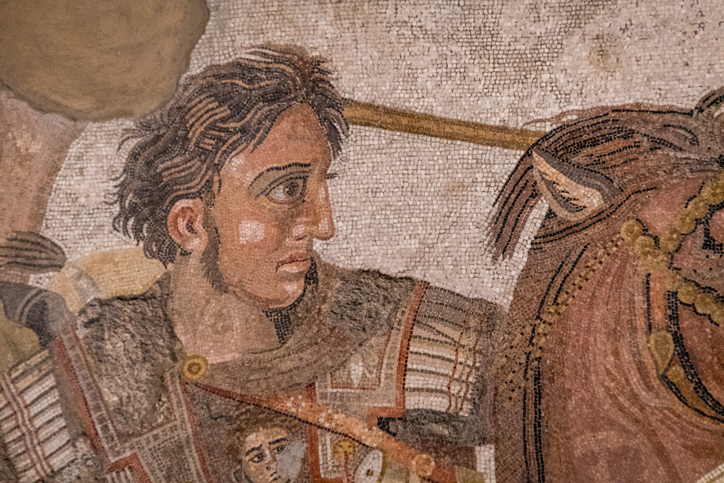
In 323 B.C., the ancient world lost its most formidable conqueror. Alexander the Great, the Macedonian king who forged an empire stretching from Greece to modern-day Pakistan, died in Babylon at the young age of 32. His sudden demise sent shockwaves through his massive kingdom, sparking a succession crisis and centuries of historical debate.
Ancient accounts report a strange detail about the days following his passing: his body reportedly did not begin to decompose for nearly a week. To his grieving generals and followers, this miraculous preservation was proof that Alexander was not a mere mortal, but a god among men.
Modern science, however, suggests a much darker, far more terrifying possibility. A recent medical hypothesis proposes that Alexander the Great might not have been dead at all when his body was being prepared for burial. Instead, a severe neurological disorder could have paralyzed him, leaving his mind perfectly alert as his followers mistook his shallow breathing for death.
If you are fascinated by ancient history or curious about how modern medicine attempts to solve thousands-of-years-old mysteries, this post will break down exactly how this theory works. We will look at the science behind the paralysis hypothesis, explain why ancient doctors might have been fooled, and examine what verified historians actually have to say about this chilling concept.
The Mystery of the Uncorrupted Corpse
According to historical records, particularly those written by the ancient Greek historian Plutarch, Alexander’s body remained remarkably pristine for six days after his official time of death. In the hot climate of ancient Babylon, a human body would typically show severe signs of decay within just a few days.
Ancient cultures often interpreted such bodily preservation as a sign of divine status. Alexander had already spent years cultivating the idea that he was the son of Zeus. A body that defied the natural laws of decomposition was exactly the kind of evidence his followers needed to cement his legacy as a living deity.
For centuries, modern historians dismissed the story of his uncorrupted corpse as pure propaganda. It was easy to assume that his loyal commanders fabricated the detail to justify their own claims to his fractured empire. However, modern medical researchers began to wonder if the ancient texts were actually reporting a genuine medical anomaly.
The Guillain-Barré Syndrome Hypothesis
In 2018, Dr. Katherine Hall, a researcher and senior lecturer at the University of Otago in New Zealand, published a groundbreaking paper in The Ancient History Bulletin. She proposed a new theory: Alexander the Great did not die from poison, malaria, or typhoid, but instead suffered from Guillain-Barré Syndrome (GBS).
Guillain-Barré Syndrome is a rare neurological disorder in which the body’s immune system attacks its own nerves. This can be triggered by a common bacterial or viral infection, something Alexander could have easily contracted during his grueling military campaigns. The condition causes progressive muscle weakness and, in severe cases, complete paralysis.
Dr. Hall noted that Alexander’s symptoms prior to his death—which included a fever, severe abdominal pain, and an ascending paralysis that started in his legs and moved upward—align perfectly with a specific variant of GBS. The most terrifying aspect of this disease is that while the physical body becomes entirely unresponsive, the patient’s brain can remain completely functional.
The Terrifying Reality of “Pseudothanatos”
If Alexander the Great was suffering from late-stage Guillain-Barré Syndrome, his body would have been fully paralyzed. This brings us to the core of Dr. Hall’s hypothesis: the concept of “pseudothanatos,” or false death.
In ancient times, physicians did not rely on taking a patient’s pulse to confirm death. Instead, they primarily checked for breath. If a patient with severe GBS is paralyzed, their body requires significantly less oxygen. As a result, their breathing becomes incredibly shallow—so faint that ancient medical practitioners might not have been able to detect it.
Furthermore, the paralysis would have caused his body temperature to drop and his pupils to become fixed and dilated. To the doctors of 323 B.C., these were the undeniable signs that the king had passed away. Under this hypothesis, Alexander’s body did not decompose because he was still alive. He could have been entirely conscious, trapped in his own motionless body, listening to his generals argue over his empire and feeling his attendants prepare him for the grave.
Fact Checking: What Historians Actually Say
While the idea of the great conqueror being buried alive makes for a gripping story, it is highly important to separate a modern medical hypothesis from established historical fact.
Historians and scientists do not universally agree on Dr. Hall’s explanation. In fact, the true cause of Alexander the Great’s death remains completely unknown and is one of the most heavily debated topics in classical history. Alternative theories continue to hold significant weight within the academic community.
Alternative Theories for His Death
Many medical historians believe that an infectious disease is the most likely culprit. Typhoid fever and malaria were highly prevalent in ancient Babylon and share some of the symptoms recorded in the weeks leading up to his death. West Nile virus has also been suggested as a possible cause, given reports of abnormal bird behavior in the city around the time of his illness.
Poisoning is another heavily debated theory. Alexander had made many political enemies, and the cutthroat nature of the Macedonian royal court meant assassination was a constant threat. Some historians argue that a slow-acting poison, perhaps administered in his wine, could account for his prolonged illness and painful decline.
A Theory, Not a Fact
Experts are quick to point out that the Guillain-Barré Syndrome explanation is purely speculative. Diagnosing a patient who has been dead for over 2,000 years is a nearly impossible task. The ancient sources we rely on were written decades or even centuries after the events occurred, meaning the symptom descriptions could be exaggerated, mistranslated, or entirely fabricated.
Most importantly, Alexander the Great’s tomb has never been found. Without physical remains to examine, modern science cannot definitively prove or disprove any medical theory regarding his passing. Therefore, the notion that he was buried alive remains an intriguing speculation rather than established fact.
Frequently Asked Questions About Alexander’s Death
Where is Alexander the Great buried?
The exact location of Alexander’s tomb remains one of history’s greatest unsolved mysteries. After his death, his body was intercepted by his general Ptolemy and taken to Egypt. It was eventually moved to the city of Alexandria, where it became a site of pilgrimage for centuries. However, the tomb was lost to history following a series of natural disasters and societal shifts in late antiquity.
How old was he when he died?
Alexander the Great was just 32 years old when he passed away. He was roughly a month shy of his 33rd birthday. Despite his incredibly short life, he managed to conquer the majority of the known world, leaving a legacy that shaped Western and Eastern civilizations.
Could modern medicine have saved him?
If Alexander was indeed suffering from Guillain-Barré Syndrome, modern medicine could likely have saved him. Today, patients with GBS are treated with intravenous immunoglobulins or plasma exchange, alongside respiratory support if their breathing muscles become paralyzed. With proper intensive care, the majority of GBS patients survive and recover their mobility.
Exploring the Legends of Antiquity
The theory that Alexander the Great was buried alive while suffering from Guillain-Barré Syndrome highlights the incredible ways modern science continues to interact with ancient history. It challenges us to rethink the miraculous stories of the past through the lens of modern medical knowledge.
However, until archaeologists uncover his lost tomb, the exact details of his death will remain shrouded in mystery. The debate over whether he succumbed to typhoid, fell victim to a political poisoning, or experienced the horrors of pseudothanatos will continue to captivate scholars for generations to come.
If you found this exploration of classical history fascinating, consider reading more about the ancient world. Dive into the primary sources like Plutarch’s Life of Alexander or explore modern historical analyses to draw your own conclusions about the legendary conqueror’s final days.
Verified References
The Guillain-Barré theory (real, published hypothesis)
- A researcher, Dr. Katherine Hall (University of Otago), proposed that Guillain-Barré Syndrome may explain Alexander the Great’s death.
- The disease causes progressive paralysis while the patient can remain mentally aware.
- This theory was published in The Ancient History Bulletin and reported by outlets like History.com and ScienceDaily.
Why people think he might have been “buried alive”
- Ancient sources report that his body showed no decomposition for several days after death.
- Hall’s theory suggests:
- Paralysis from Guillain-Barré could have made him appear dead
- His breathing may have been too shallow to detect with ancient methods
- Death might have been misdiagnosed (“pseudothanatos”)
- This leads to the speculative idea that he could have been alive (but paralyzed and conscious) when declared dead.